2023 | Article: Governor General Awards for Visual Arts 2022
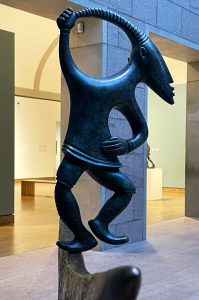 Although predominantly working in stone, [David Ruben] Piqtoukun also casts in metal. Early on in his career, an interest in Rodin and his casting techniques left an impression on Piqtoukun, who has visited Paris multiple times to continue to study the work of the French artist. The sculpture selected for the GGArts interventions, Dancing on the Moon II (2016), calls to mind the material for which Piqtoukun is known: bronze, appearing at first glance as rock. The three parts – a mound, crescent moon and female Shaman – visually merge with the granite plinth, floor and bricks that enclose the Water Court of the Michael and Sonja Koerner Family Atrium. Referencing an Inuvialuit oral tradition, the composition “highlights concepts of spiritual flight and creativity” as well as the “sense of euphoria one gets from achieving a rare accomplishment.” The chosen location places Piqtoukun’s Dancing on the Moon II in proximity to Lost Bridal Veil (2015), a sculpture by Anishinaabe artist Michael Belmore that cascades from the granite wall. The rivers and tributaries of Manhattan are carved into copper sheets evoking plummeting water, the title referencing Bridal Veil Falls on Manitoulin Island. Both the material and the island are of spiritual significance to the Anishinaabeg. Belmore and Piqtoukun share an affinity for stone, land and mythology, their carvings having been previously shown together in the 2005 Cornerstone exhibition at Ottawa’s Gallery 101. The works rest in the only space in the galleries where water and sky are experienced. The dynamic allows for light, along with its absence, to mark the passing of time, a reminder that despite arriving at a destination already known a renewed perspective is possible.
Read full article on National Gallery of Canada Magazine.
Image: Leah Snyder